History-
Diwali dates back to ancient times in India, as a festival after the summer harvest in the Hindu calendar month of Kartika. The festival is mentioned in Sanskrit scriptures such as the Padma Purana, the Skanda Purana both completed in second half of 1st millennium AD but believed to have been expanded from a core text from an earlier era. The diyas (lamps) are mentioned in Skanda Purana to symbolically represent parts of sun, the cosmic giver of light and energy to all life, who seasonally transitions in the Hindu calendar month of Kartik. Hindus in some regions of India associate Diwali with the legend of Yama and Nachiketa on Kartika amavasya (Diwali night).The Nachiketa story about right versus wrong, transient wealth versus true wealth, ignorance versus knowledge is recorded in Katha Upanishad composed in 1st millennium BC.
King Harsha in the 7th century Sanskrit play Nagananda mentions Diwali as Deepapratipadutsava, where lamps were lit and newly engaged brides and grooms were given gifts.Rajasekhara referred to Diwali as Dipamalika in his 9th centuryKavyamimamsa, wherein he mentions the tradition of homes being whitewashed and oil lamps decorating homes, streets and markets in the night. The Persian traveller and historian Al Biruni, in his 11th century memoir on India, wrote Diwali being celebrated by Hindus on New Moon day of the month of Kartika.
Significance-
Diwali is one of the happiest holidays in Nepal and India with significant preparations. People clean their homes and decorate them for the festivities. Diwali is one of the biggest shopping seasons in Nepal and India; people buy new clothes for themselves and their families, as well as gifts, appliances, kitchen utensils, even expensive items such as cars and gold jewelry. People also buy gifts for family members and friends which typically include sweets, dry fruits, and seasonal specialties depending on regional harvest and customs. It is also the period when children hear ancient stories, legends, myths about battles between good and evil or light and darkness from their parents and elders. Girls and women go shopping and create rangoli and other creative patterns on floors, near doors and walkways. Youth and adults alike help with lighting and preparing for patakhe (fireworks).
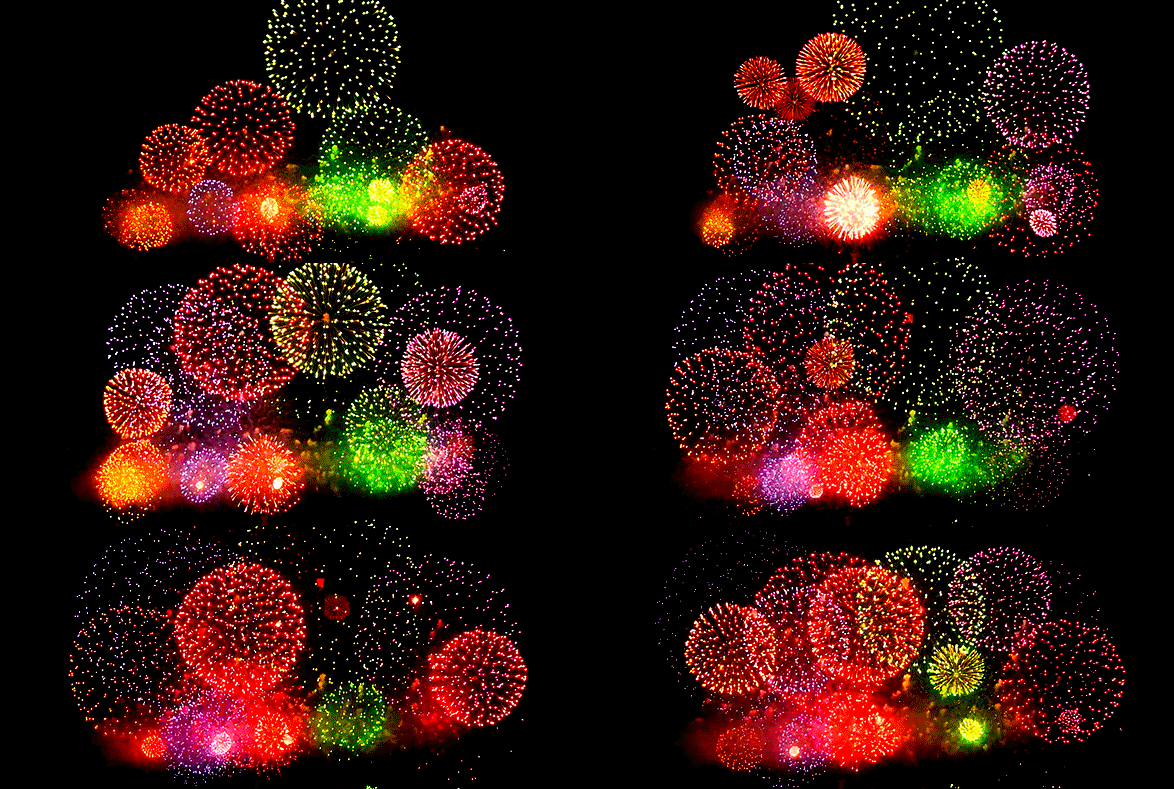
There is significant variation in regional practices and rituals. Depending on the region, prayers are offered before one or more deities, with most common being Lakshmi – the goddess of wealth and prosperity. On Diwali night, fireworks light up the neighborhood skies. Later, family members and invited friends celebrate the night over food and sweets.
Spiritual significance-
Diwali is celebrated by Hindus, Jains, and Sikhs to mark different historical events, stories or myths but they all symbolise the victory of light over darkness, knowledge over ignorance, good over evil, hope over despair.
The Yoga, Vedanta, and Samkhya schools of Hindu philosophy share the belief that there is something beyond the physical body and mind which is pure, infinite, and eternal, called the Atman. The celebration of Diwali as the "victory of good over evil" refers to the light of higher knowledge dispelling all ignorance, the ignorance that masks one's true nature, not as the body, but as the unchanging, infinite, immanent and transcendent reality. With this awakening comes compassion and the awareness of the oneness of all things, and knowledge overcomes ignorance. Diwali is the celebration of this inner light over spiritual darkness, knowledge over ignorance, right over wrong, good over evil.
Hinduism-
The religious significance of Diwali varies regionally within India, depending on the school of Hindu philosophy, regional myths, legends, and beliefs.
Many see Diwali honouring the return of the god Rama, his wife Sita and his brotherLakshmana from exile of 14 years, as told in the ancient Hindu epic Ramayana.To some, Diwali marks the return of Pandavas after 12 years of Vanvas and one year of agyatavas in the other ancient Hindu epic Mahabharata. Many other Hindus believe Diwali is linked to the celebration of Lakshmi, the goddess of wealth and prosperity, and wife of the god Vishnu. The five day festival of Diwali begins on the day Lakshmi was born from the churning of cosmic ocean of milk by the gods and the demons; the night of Diwali is the day Lakshmi chose Vishnu as her husband and then married him. Along with Lakshmi, devotees make offerings toGanesha who symbolizes ethical beginnings and fearless remover of obstacles;Saraswati who symbolizes music, literature and learning; and Kubera who symbolizes book keeping, treasury and wealth management. Other Hindus believe that Diwali is the day Vishnu came back to Lakshmi and their abode in the Vaikuntha; so those who worship Lakshmi receive the benefit of her good mood, and therefore are blessed with mental, physical and material well-being during the year ahead.
Hindus in India's eastern region, such as West Bengal, worship the goddess Kali instead of Lakshmi, and call the festival Kali Puja. In India's Braj and north central regions, the god Krishna is recognized. People mark Mount Govardhan, and celebrate legends about Krishna. In other regions, the feast of Annakoot is celebrated, with 56 or 108 different cuisines prepared, offered to Krishna, then shared and celebrated by the local community.
In West and certain Northern parts of India, the festival of Diwali marks the start of a new Hindu year.
Rituals: Dhanteras-
Dhanteras starts off the five day festival. Starting days before and through Dhanteras, houses and business premises are cleaned, renovated and decorated. Women and children decorate entrances with Rangoli – creative colourful floor designs both inside and in the walkways of their homes or offices. Boys and men get busy with external lighting arrangements and completing all renovation work in progress. For some, the day celebrates the churning of cosmic ocean of milk between the forces of good and forces of evil; this day marks the birthday of Lakshmi – the Goddess of Wealth and Prosperity, and the birthday of Dhanvantari – the God of Health and Healing. On the night of Dhanteras, diyas (lamps) are ritually kept burning all through the nights in honor of Lakshmi and Dhanvantari.
Dhanteras is also a major shopping day, particularly for gold or silver articles. Merchants, traders and retailers stock up, put articles on sale, and prepare for this day. Lakshmi Puja is performed in the evening. Some people decorate their shops, work place or items symbolizing their source of sustenance and prosperity.
An ancient legend ascribes the occasion to on interesting story about the 16-year-old son of King Hima. His horoscope predicted his death by snake-bite on the fourth day of his marriage. On that particular day, his newly-wed wife did not allow him to sleep. She laid out all her ornaments and lots of gold and silver coins in a heap at the entrance of the sleeping chamber and lit lamps all over the place. Then she narrated stories and sang songs to keep her husband from falling asleep. The next day, when Yama, the god of Death, arrived at the prince’s doorstep in the guise of a Serpent, his eyes were dazzled and blinded by the brilliance of the lamps and the jewellery. Yama could not enter the Prince's chamber, so he climbed on top of the heap of gold coins and sat there the entire night listening to the stories and songs. In the morning, he silently went away. Thus, the young prince was saved from the clutches of death by the cleverness of his new bride, and the day came to be celebrated as Dhanteras. The following day came to be called Naraka Chaturdashi ('Naraka' means hell and Chaturdashi means 14th). It is also known as ‘Yamadeepdaan’ as the ladies of the house light earthen lamps or ‘deep’ and these are kept burning throughout the night glorifying Yama, the God of Death. Since this is the night before Diwali, it is also called 'Chhoti Diwali' or Diwali minor Diwali.
According to another popular legend, when the Gods and demons churned the ocean for Amrita or nectar, Dhanvantari (thephysician of the Gods and an incarnation of Vishnu) emerged carrying a jar of the elixir on the day of Dhanteras.
Naraka Chaturdasi-
The puja is performed with oil, flowers, and sandalwood. Coconuts are also offered to Hanuman and Prasad of sesame seed, jaggery and rice flakes (poha) with ghee and sugar.
The rituals of Kali Choudas is strongly suggestive of the origin of Diwali as a harvest festival is performed. On this day delicacies are prepared from pounded semi-cooked rice (called Poha or Pova). This rice is taken from the fresh harvest available at that time. This custom is prevalent both in rural and urban areas especially in Western India.
On this day, a head wash and application of kajal in the eyes is believed to keep away the kali nazar (evil eye). Some say that those who are into tantra, learn their 'mantras' on this day. Alternatively, people offer Nivet is local to where they are originally from. This goddess is called their Kul Devi, in order to cast off evil spirits. Some families also offer food to their forefathers on this day. The second day ofDiwali is known as Kali Choudas in Gujarat, Rajasthan & few part of Maharashtra.
On this day Hindus get up earlier than usual. The men will rub their bodies in perfumed oils before bathing. Afterwards, clean clothes are worn; some people wear new ones. A large breakfast is enjoyed with relatives and friends. In the evening, a mix of bright and loud fireworks are set off in an atmosphere of joyful fun and noise. Special sweet dishes are served as part of the midday meal. House are lit with oil lamps during the evening.
In Goa, paper-made effigies of Narakasura, filled with grass and firecrackers symbolising evil, are made. These effigies are burnt at around four o'clock in the morning and then firecrackers are burst, and people return home to take a scented oil bath. Lamps are lit in a line. The women of the house perform aarti of the men, gifts are exchanged, a bitter berry called kareet is crushed under the feet in token of killing Narakasura, symbolising evil and removal of ignorance. Different varieties ofPoha and sweets are made and eaten with family and friends.
Lakshmi Puja-
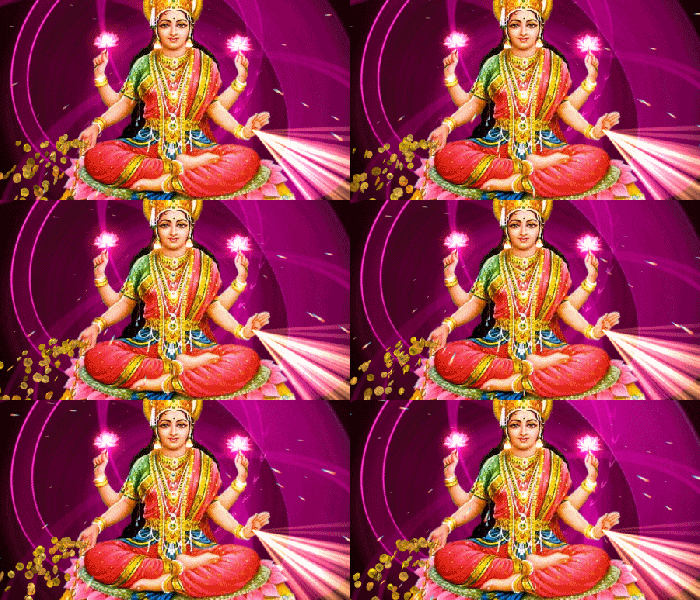
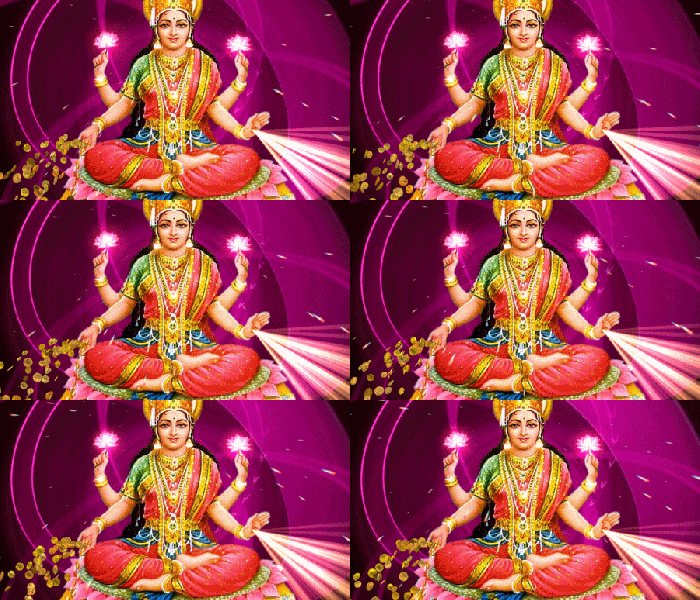
Lakshmi Puja, or the worship of the goddess of wealth, is the main event of Diwali in North and West India. It is popularly believed that Lakshmi likes cleanliness and will visit the cleanest house first. Hence, the broom is worshiped with offerings of haldi (turmeric) and kumkum (vermilion) on this day. Lamps are lit in the evening to welcome the goddess as they are believed to light up her path. On this day, a supported light of knowledge is said to dawn upon humanity. This self-enlightenment is expressed through the twinkling lamps that illuminate the abode of the worshippers. It is believed that on this day, the goddess walks through the green fields and loiters through the by-lanes and showers her blessings on mankind for glory and prosperity.
The third day of Diwali is believed to be the most auspicious day; this is when Lakshmi Puja is performed. With pomp and ceremony, Lakshmi is invited into the homes of devotees to partake of the gifts that are a part of the puja. The most auspicious time for the puja is decided when amavasya tithi prevails during pradosh kaal or the evening time. On this day, the sun enters its second course and passes the constellation Libra, which is represented by the balance or scale. Hence, the sign of Libra is believed to suggest the balancing and closing of account books.
Lakshmi Puja is celebrated as a part of Tihar, a second national festival of Nepal after Dashain. In Nepal, it is celebrated for five days, which include Kag (crow) Tihar; Kukur (dog) Tihar]; Gai (cow) Tihar in the morning and Laxmi pooja at night; Maha puja (self puja); Goru (Ox and Bull) Tihar and Gobardhan Puja; and finally, Bhai Tika (bhai dhooj)—respectively the first, second, third, fourth and fifth days. On Lakshmi Puja in Nepal, people buy gold and silver, precious gemstones, new utensils of copper, brass and bronze as a sign of good luck, prosperity, money and wealth. These are then used to Lakshmi at night. Nepalese people perform this worship at a place cleansed with holy water, cow dung and red mud; they light the whole house with candles and lamps. From Lakshmi Puja, Deusi and Bhailo is played by gathering with friends.
Lakshmi Puja consists of a combined puja of five deities: Ganesha is worshiped at the beginning of every auspicious act asVighneshvara; goddess Lakshmi is worshiped in her three forms; Mahalakshmi the goddess of wealth and money,Mahasaraswati the goddess of books and learning, and Mahakali. Kubera the treasurer of the gods is also worshiped.
Padwa ,Balipratipada-
The rituals observed on the Bali Padyami day have variations from state to state. In general, on this sacred festival day, Hindus exchange gifts, as it is considered a way to please Bali and the gods. After the ceremonial Oil Bath [a particular usage in Indian English, which denotes that oil is smeared over the body and then washed by soap or shikakai (means "fruit for hair" and is a traditional shampoo used in India), during bath] (considered essential as purification of selfish desires) by all the family members, wearing of new clothes is kind of mandatory. People decorate the main hall of the house with a Rangoli or Kolam drawn with powder of rice in different colours, thereafter Bali and his wife Vindhyavali are worshipped. Symbolically, seven forts are also built out of clay or cow dung to worship Bali. In the evening, as night falls, door sills of every house and temple are lighted with lamps arranged in rows. People remember Bali's kingdom with the slogan: "Let the ideal kingdom of Bali dawn at the earliest on earth."
Another observance that is practised, mostly in North India, on this day is of playing the gambling game called pachikalu(dice game), which is linked to a legend. It is believed that god Shiva and his consort Parvati played this game on this festival day when Parvati won. Following this, their son Kartikeya played with Parvati and defeated her. Thereafter, his brother, the elephant-headed god of wisdom Ganesha played with him and won the dice game. But now this gambling game is played only by family members, symbolically, with cards.
In Maharashtra, it is celebrated as Padva or Bali Pratipada. The day is linked to worship of king Bali. Men present gifts to their wives on this day.
The farming community celebrates this festival, particularly in Tamil Nadu and Karnataka, by performing Kedargauri vratam (worship of goddess Kedar-Gauri – a form of Parvati), Gopuja (worship of cow), and Gouramma puja (worship of Gauri – another form of Parvati). Before worship of cows, on this day, the goushala(cowshed) is also ceremoniously cleaned. On this day, a triangular shaped image of Bali, made out of cow-dung is placed over a wooden plank designed with colourful Kolam decorations and bedecked with marigold flowers and worshipped.
The day is celebrated as Govardhan Puja in North India. It is celebrated to observe the lifting of Govardhana hill by god Krishna to save his kinsmen and cattle from rain and floods.
In West Bengal-
Kali puja (like Durga Puja) worshipers honor goddess Kali in their homes in the form of clay sculptures and in pandals (temporary shrines or open pavilions). She is worshipped at night with Tantric rites and mantras. She is prescribed offerings of red hibiscus flowers, animal blood in a skull, sweets, rice and lentils, fish and meat. It is prescribed that a worshiper should meditate throughout the night until dawn. Homes may also practice rites in the Brahmanical (mainstream Hindu-style, non-Tantric) tradition with ritual dressing of Kali in her form as Adya Shakti Kali. Animals are ritually sacrificed on Kali Puja day and offered to the goddess. A celebration of Kali Puja in Kolkata and in Guwahati is also held in a large cremation ground where she is believed to dwell in both places.
The pandals also house images of god Shiva - the consort of Kali, Ramakrishna and Bamakhepa- two famous Bengali Kali devotees along with scenes from mythology of Kali and her various forms along with Mahavidyas, sometimes considered as the "ten Kalis". The Mahavidyas is a group of ten Tantric goddesses headed by Kali. People visit these pandalsthroughout the night. Kali Puja is also the time for magic shows and theatre, fireworks. Recent custom involves drinkingwine.
In the Kalighat Temple in Kolkata and in Kamakhya Temple in Guwahati, Kali is worshipped as Lakshmi on this day so as to reflect an essence of Vaishnava Haldars on Kali worship. The temple is visited by thousands of devotees who offer animal sacrifices to the goddess. Another famous temple dedicated to Kali in Kolkata is Dakshineswar Kali Temple. The famous Kali devotee Ramakrishna was a priest at this temple. The celebrations have changed little from his time.
Diwali is celebrated around the world, particularly in countries with significant populations of Hindu, Jain and Sikh origin. These include Sri Lanka, Pakistan, Myanmar, Thailand, Malaysia, Singapore, Indonesia, Australia, New Zealand, Fiji,Mauritius, Kenya, Tanzania, South Africa, Guyana, Suriname, Trinidad and Tobago, the Netherlands, Canada, the United Kingdom, United Arab Emirates, and the United States. With more understanding of Indian culture and global migration of people of Indian origin, the number of countries where Diwali/Deepavali is celebrated has been gradually increasing. While in some countries it is celebrated mainly by Indian expatriates, in others it is becoming part of the general local culture. In most of these countries Diwali is celebrated on the same lines as described in this article with some minor variations. Some important variations are worth mentioning.
Air Pollution-
Scholars report that air pollution worsens not as much during fireworks, but after fireworks celebration is over, with fine particulate matter (PM2.5) levels about four times worse than pre-Diwali levels, and average levels about two times a normal day. This study indicated that there is high accumulation of PM2.5 generated due to fireworks on Diwali festival which remains suspended in the air. The peak pollution lasts for about one day, and the pollutant concentrations return to background levels after 24 hours. Attri et al. report ground level ozone pollution is also formed Diwali, as with fireworks celebrations around the world on New Year eve or respective national Independence Day. The dispersal and decay times for increased ground level ozone is also about one day.
Description-
Diwali is a five-day festival with main Diwali celebrated on the third day and the darkest night of the lunar month. Hindus, Jains, and Sikhs light up their homes, temples, shops and offices with diyas, candles and lanterns, with countless little lights illuminating neighborhoods everywhere. Diwali is also marked with fireworks and floor rangoli designs; the festival is a major celebration of flavors with feasts and numerous mithai (sweets, desserts), as well as homecoming and bonding time that ritually brings family and friends together every year. Diwali is also the major festival when social and cultural bonds are annually renewed, particularly in urban areas. Communities and associations organize, invite others to dinners, dance events, rangoli making, temple decoration and parties over food and arts. Many towns organize community parades and fairs with parades or music and dance performances in parks. Some Hindus, Jains and Sikhs send Diwali greeting cards to loved ones near and far during the festive season, occasionally with boxes of Indian confectionery.
Regional practices and rituals vary significantly. Diwali is a post-harvest celebration, marking the abundance created by the monsoon crop on the Indian subcontinent. Depending on the region, the celebrations include prayers before one or more Hindu deities, with the most common being Lakshmi. According to David Kinsley – an Indologist and a scholar of goddess-related Indian religious traditions, Lakshmi symbolizes three themes: wealth and prosperity, fertility and abundant crops, as well as good fortune. The merchant community seeks Lakshmi's blessings in all their ventures. They ritually close their account year and worship their tools of trade such as the new account book. The fertility motifs appear in the agricultural offerings before Lakshmi by farming families, who thank her for what the recent harvests and seek her blessings for prosperous future crops. A symbolic piece of the traditional fertilizer, a dried piece of cow dung, is included in the ensemble in Odisha and Deccan region villages, which states Kinsley is an agricultural motif. Another aspect of the festival is remembering the ancestors, particularly any recently dead family members.
Rituals and preparations for Diwali begin days or weeks in advance, typically after the festival of Dusshera that precedes Diwali by about 20 days. The festival formally begins two days before the night of Diwali, and ends two days thereafter.

Dhanteras-
Dhanteras, also referred to as Dhanatrayodashi or Yamatrayodashi, starts off the five day Diwali festival. Dhanteras is derived from Dhan (wealth) and teras (thirteenth), and it marks the thirteenth day of the Kartik month's dark fortnight.
Many Hindus clean, renovate and decorate their houses and business premises, either on or by Dhanteras. Little oil earthen lamps called diyas are ritually lit up near Lakshmi and Ganesha iconography and kept illuminated over the next five nights. Women and children decorate entrances with Rangoli – creative colourful floor designs made of rice floor, flower petals and colored sand – both inside and in the walkways of their homes or offices. Boys and men decorate the roofs and walls with lights of family homes, markets and temples starting on this day. The day also marks a major shopping day to purchase new utensils, home equipment, jewelry, firecrackers and other items. On the evening of Dhanteras, families pray (puja) before the Lakshmi and Ganesha icons, with offerings such as puffed rice, candy toys, rice cakes and batashas (hollow sugar cakes).
According to Tracy Pintchman, Dhanteras signifies themes of annual renewal, cleansing and auspicious beginning for the next year. The term "Dhan" for this day also connotes the Ayurvedic icon Dhanvantari, who is believed to have emerged from the "churning of cosmic ocean" on the same day as Lakshmi. Dhanvantari symbolizes healing and health. Some communities, such as those particularly active in Ayurvedic and health-related professions, pray or perform havan rituals to Dhanvantari on the Dhanteras.
Burn injuries-
There is an increase in burn injuries in India during Diwali from fireworks. A firework called anar (fountain) has been found to cause 65% of the injuries. Adults are the typical victims. Newspapers advise splashing cold water immediately after the burn, which along with proper nursing of the wound helps reduce complications. Most burns are Group I type burns (minor) requiring outpatient care.
